
Do Staffing Agencies Work in Boston? A Deep Dive for Employers and HR Leaders

Boston’s economy is a patchwork of industries, from manufacturing plants to tech startups and engineering firms across the state. Employers face tough competition for talent, especially in specialized fields like engineering, IT, and executive leadership.
When hiring becomes complex, many companies wonder whether staffing agencies in Boston truly make a difference. Are they worth the investment? How do they impact the hiring process? Let’s explore these questions with data, research, and insights relevant to HR leaders and recruiters.
Boston’s Labor Market Challenges
Boston’s unemployment rate in early 2025 sits around 4.2 percent, similar to the national average. While that figure offers some insight, it does not fully capture the hiring difficulties many employers face. Across the region, companies report persistent challenges sourcing skilled professionals in core business functions.
Sales teams, for instance, struggle to find experienced account executives and sales managers. Marketing departments seek qualified candidates in brand strategy, content development, and digital growth. The demand for data analysts and business intelligence specialists continues to rise as organizations become more analytics-driven. In executive leadership, employers face long lead times and limited candidate pools for C-suite roles, especially in competitive sectors like tech, marketing, and sales.
Statewide, there are approximately 290,000 open jobs and only 145,000 unemployed workers, creating nearly two openings for every job seeker. As qualified candidate pools shrink, competition intensifies. Employers often lose talent to better offers, flexible work arrangements, or out-of-state opportunities. Under such conditions, the traditional hiring approach involving job postings and passive applications falls short. Staffing agencies aim to bridge this gap. But how effective are they in Boston’s market?
Efficiency Matters: How Staffing Agencies Shorten Time to Hire
One major headache for HR teams involves the time required to fill critical roles. According to Staffing Industry Analysts, companies working with staffing firms can reduce time to fill by 30 to 50 percent. This improvement in efficiency is significant.
Consider a manufacturing firm needing a process engineer. Internal recruiters might take over 40 days to source, screen, and hire the right candidate. Meanwhile, the position remains open, production slows, and deadlines slip. Staffing agencies tap into existing talent pools ready to engage immediately. Agencies handle screening and vetting candidates before presenting a shortlist.
Here’s where your company will see real results when you use an Boston staffing agency:
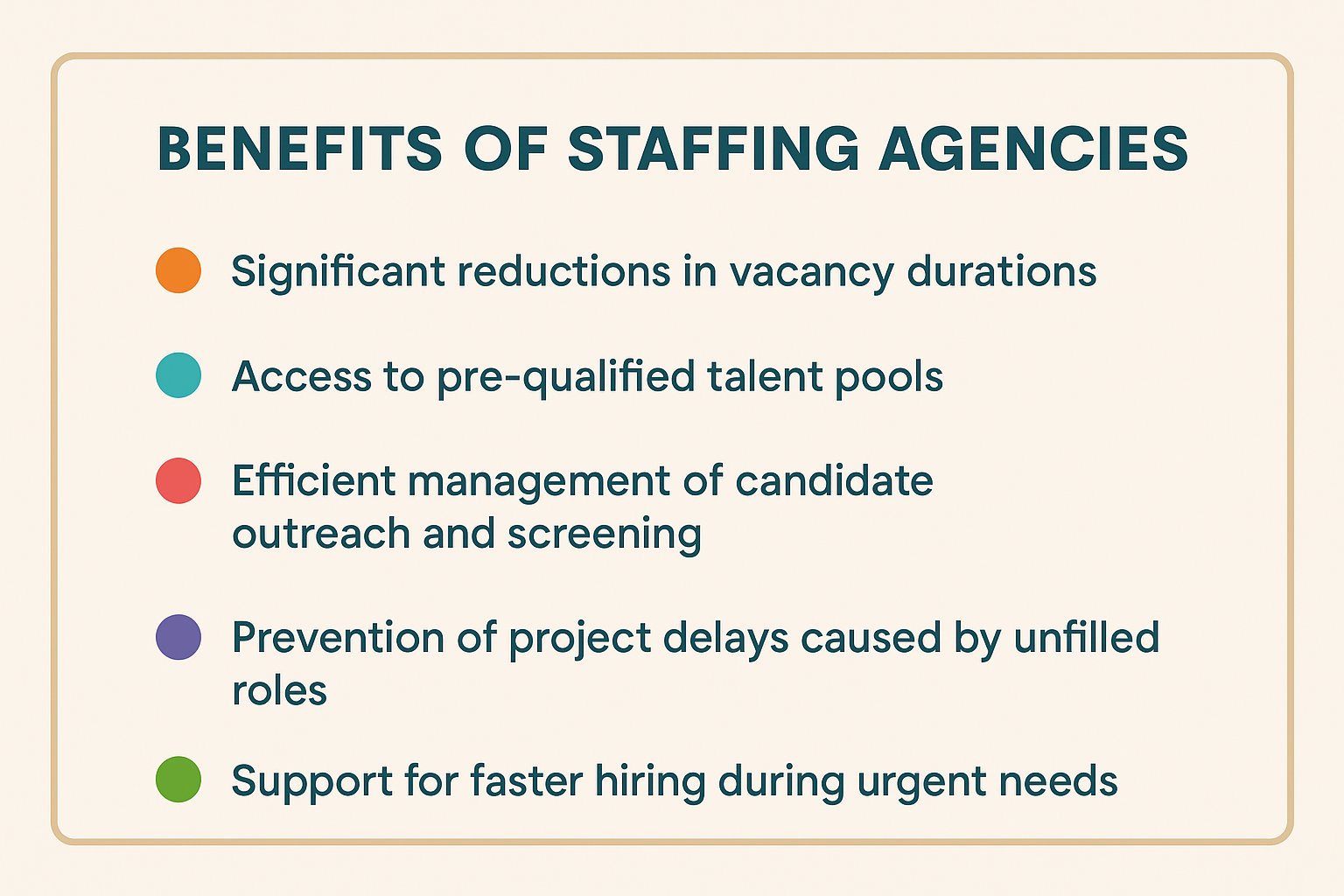
The Society for Human Resource Management reports average time to fill across industries often exceeds 42 days. Agencies typically deliver candidates within 20 to 25 days. Such a difference saves money and keeps projects on track. In Boston, where specialized roles are difficult to fill, this speed prevents costly downtime.
Staffing Quality and Job Candidate Retention
Filling a role quickly represents only half the challenge. The new hire must perform well and remain with the company. Research indicates staffing placements generally have retention rates equal to or better than internal hires, largely due to thorough screening and improved culture fit. In Boston’s engineering and manufacturing sectors, temp to hire placement is common.
Employers use temporary and temp to hire staffing to test candidates before making long-term commitments. It reduces turnover and cuts hidden costs associated with bad hires. The U.S. Department of Labor estimates poor hiring decisions can cost 30 percent of a worker’s annual salary. Harvard Business Review highlights how temp to hire foster better retention and smoother onboarding.
Candidates familiar with company expectations transition into permanent staffing roles more smoothly.
Unlocking Passive Talent: A Hidden Advantage of Staffing Agencies
Most job seekers do not actively apply for new roles. Studies estimate a large portion of the workforce remains passive, not actively searching but open to opportunities. Staffing agencies cultivate long-term relationships with such professionals. Pipelines build through networking, industry events, and personal outreach.
Access to passive talent provides employers with a competitive edge. Boston companies competing in technical fields benefit considerably. Aerospace, IT, and engineering staffing firms can find top candidates emerging from hidden pools. Internal recruiting teams rarely reach passive candidates as effectively. Agency networks open doors to high-performing professionals who might otherwise remain out of reach.
Flexibility: How Staffing Agencies Help Boston Employers Scale
Boston’s industries experience cyclical demand. Manufacturing ramps up for contracts. The American Staffing Association reports 55 percent of companies rely on staffing firms to scale labor up and down.
Agencies provide temporary staffing or contract workers, which allows companies to respond quickly without committing to long-term payroll costs. Temp to hire models offer a low-risk way to evaluate talent. Employers observe work performance and cultural fit before extending permanent offers.
Here’s why you want flexibility when hiring:
- Quick scaling of labor to meet demand
- Access to specialized skills on short notice
- Opportunities to evaluate candidates in real work settings
- Reduction in overstaffing and layoffs
- Maintenance of operational continuity
Flexibility reduces hiring mistakes and prevents overstaffing. Boston companies avoid costly layoffs and maintain operational agility.
Measuring the ROI: What Staffing Agencies Deliver Financially
Many employers hesitate due to upfront fees, but return on investment often far exceeds initial costs. Staffing Industry Analysts estimate every dollar spent on staffing services can yield four to eight dollars in value. This substantial ROI results from reducing vacancy times, minimizing costly hiring mistakes, and lowering training expenses.
Faster Hiring Saves Money
Open positions slow productivity, delay projects, and strain existing staff. Staffing agencies accelerate hiring, enabling teams to maintain momentum and meet business goals. Avoiding poor hires proves equally important. The U.S. Department of Labor estimates a bad hire can cost up to 30 percent of the employee’s annual salary when accounting for lost productivity, retraining, and turnover.
Better Hiring Data
In addition to cost savings, agencies provide data-backed insights that enhance hiring decisions. Metrics such as time-to-fill, candidate quality, and retention rates offer clear visibility into recruitment effectiveness. Such information helps forecast hiring needs, allocate budgets wisely, and adjust strategies as market conditions evolve.
Challenges to Consider When Working With Staffing Agencies
Staffing agencies offer many advantages, but successful partnerships depend on strong communication and collaboration.
Learning the Company
One common challenge involves ensuring agencies fully understand company culture and specific role requirements. Without clear understanding, agencies may present candidates who are not well aligned, causing delays and frustration. Providing detailed job descriptions, sharing cultural insights, and offering timely feedback helps agencies deliver better candidate matches.
Organized Management
Integrating temporary or contract workers demands thoughtful management. Proper onboarding proves crucial to teaching job responsibilities and fostering a sense of inclusion. Overlooking these aspects can harm morale and reduce productivity among both new hires and existing employees.
Compliance Issues
Legal compliance remains an essential focus. Boston employers must stay current on wage laws, overtime rules, and contract standards. Although agencies assist with compliance, ultimate responsibility resides with the employer. Errors may lead to penalties or legal complications. Clear contracts, thorough agreement reviews, and consulting legal experts when necessary represent critical practices.
Transparency
Clear expectations, open communication, careful onboarding, and diligent legal oversight provide the foundation for staffing partnerships that consistently deliver value and support long-term business success.
We Want To Hear From You
We recruit heavily in AM and retail fixtures & POP. If you’re an expert in either field, let’s start a conversation.