
Do Staffing Agencies Drug Test in Boston?
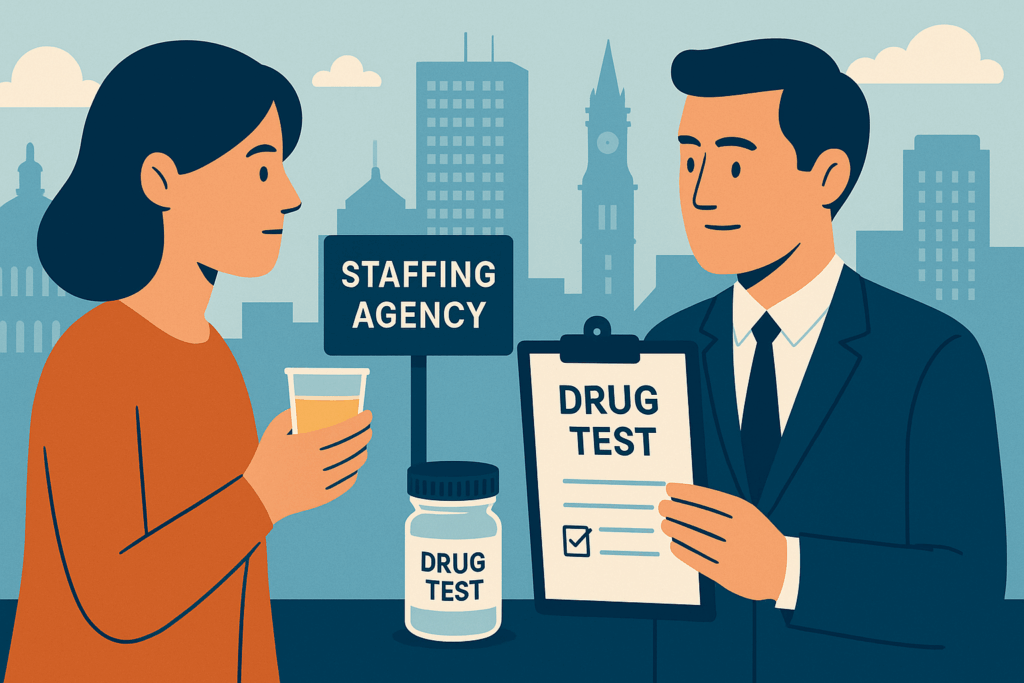
If you’re hiring through a staffing agency in Boston, drug testing may be part of the process.
Whether you’re filling roles in manufacturing, logistics, healthcare, or skilled trades, you need to know when testing applies, what it covers, and how it affects placements. Massachusetts law allows testing, but your company policy sets the tone.
Why Drug Testing Still Matters in Boston
Safety in High-Risk Industries
Logistics, manufacturing, and healthcare jobs require a higher level of accountability. When someone shows up impaired, the risks include damaged equipment, missed deadlines, or injuries. Drug screening gives you a layer of protection before bringing someone on-site.
Risk Sharing in Temp and Contract Hiring
If you’re hiring temp or temp to hire roles, you share responsibility with your recruitment service. Most include screening as part of their standard process. That keeps hiring compliant and protects both parties.
Federal Contracts Require Testing
Drug screening isn’t optional under Department of Transportation or Department of Defense rules. If your company works on federal contracts, you’ll need to follow those testing guidelines from the start.
Consistency Protects Your Team
Even when testing isn’t legally required, having a standard process reduces confusion and limits bad placements. Recruitment services help apply that process consistently across your candidate pool. For government contracts, testing isn’t optional. If you work under DOT or DOD regulations, screening must follow federal rules from the start.
What Massachusetts Law Allows
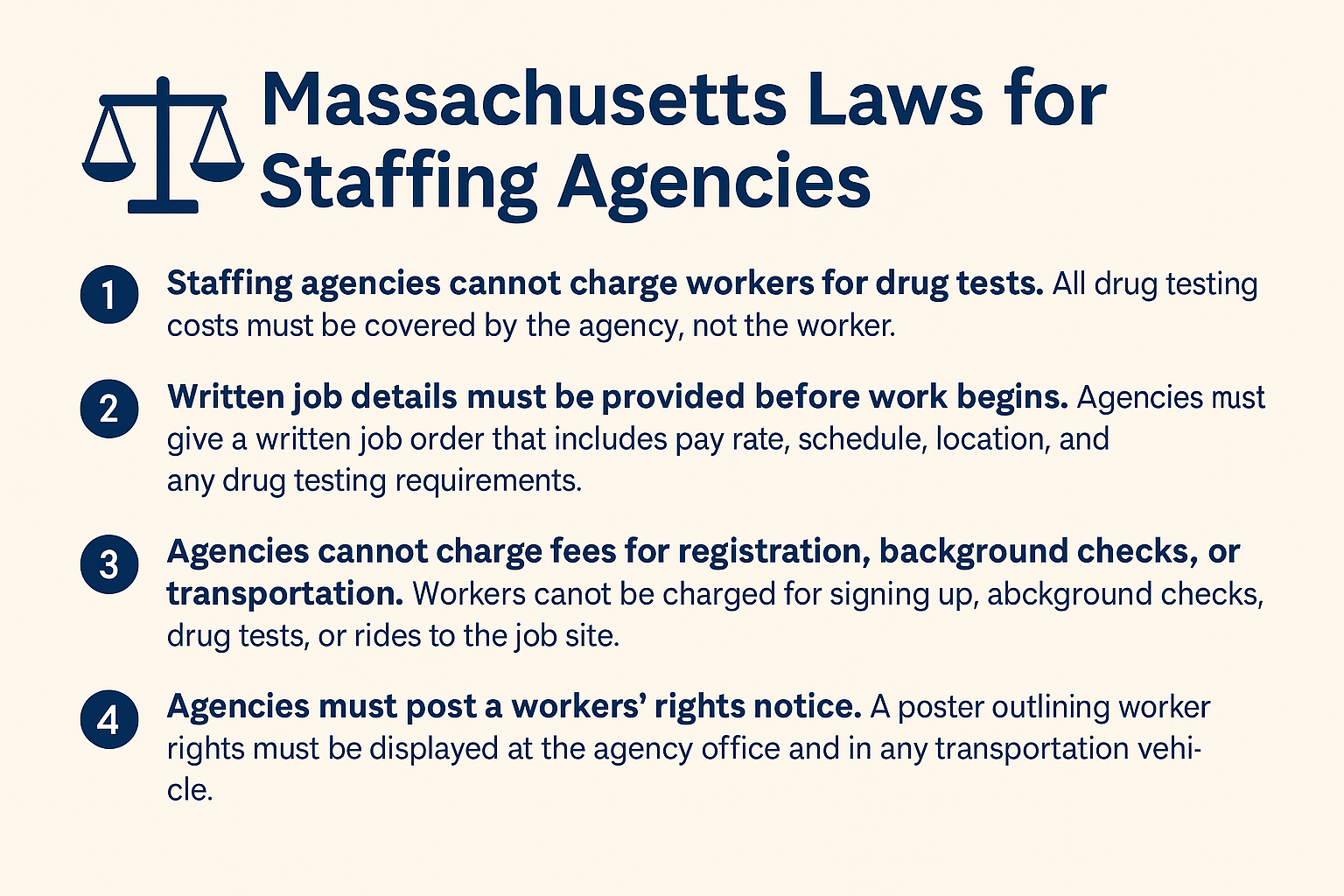
Massachusetts allows workplace drug testing, but only under specific legal conditions. Employers may require pre-employment drug tests if they are applied consistently after a conditional job offer, in line with Massachusetts General Law Chapter 149, Section 19B.
For current employees, testing is permitted when there is reasonable suspicion of drug use based on documented behavior. This standard has been upheld in decisions like Board of Review Decision 0022-1359-86, which supported disciplinary action following observed impairment.
Post-accident testing is also allowed when there’s reason to believe substance use played a role, as seen in Decision 0019-7961-15. However, random drug testing of employees in non–safety-sensitive positions is generally prohibited unless clearly justified.
Employers should document testing policies, inform employees in advance, and ensure procedures are job-related and nondiscriminatory to comply with Massachusetts law.
Common testing situations include:
- Conditional job offers
- Safety-sensitive job roles
- Participation in state safety programs
If you’re enrolled in the program, testing becomes a requirement—not just a policy choice.
When Staffing Agencies Use Drug Tests
Staffing agencies in Boston follow your lead when it comes to drug screening. Testing most often happens after a conditional offer, especially for roles that involve physical labor, use of machinery, or exposure to risk. This includes production, distribution, logistics, and field work. When screening is part of your process, the agency builds it into the placement timeline.
Agencies are not required by law to test, but many have protocols in place. If you want screening tied to specific roles, include that direction upfront. Drug testing becomes more than a policy. It becomes a shared expectation that influences how candidates are evaluated and where they are assigned.
Office roles or remote positions may not require testing unless it’s part of your internal policy. Recruitment services follow your lead. Make your expectations known upfront. Some positions may not require testing unless it’s part of your internal policy. Agencies follow your lead, so make expectations clear.
How Staffing Agencies Handle Testing
When drug screening is required for permanent placement or temporary staffing, most agencies handle the logistics. They coordinate directly with certified labs, set the appointment, and manage the paperwork. Urine tests are the default, but hair and saliva tests may be used for specific roles or timelines. The results are delivered to the agency and passed on to you as either a pass or fail.
Typical steps in the process:
- Lab selection and scheduling
- Sample collection and verification
- Result reporting and follow-up
Recruitment services often use labs certified by the Substance Abuse and Mental Health Services Administration to meet legal standards and chain of custody protocols.
What Substances Are Screened in Boston
Most Boston staffing agencies begin with a five-panel drug test. That includes:
- Marijuana
- Cocaine
- Amphetamines
- Opiates
- Phencyclidine.
Depending on your request or the role requirements, the agency may extend the panel to include additional substances. A ten-panel test adds benzodiazepines, barbiturates, methadone, methaqualone, and propoxyphene.
You may want to consider your industry’s exposure to federal guidelines. If you operate under transportation regulations or government funding, stricter tests are often needed. Discuss your obligations with the agency early so the correct test is administered.
Boston allows medical marijuana, but you can still test for it. You’re not required to accommodate use, even with a valid card. If your company has a zero-tolerance policy, that position is protected under Boston law., but you can still test for it. You’re not required to accommodate use, even with a valid card. If your company has a zero-tolerance policy, that position is protected under Boston law.
What Happens After a Failed Test
If a candidate fails a drug test, the agency removes them from consideration. Some agencies allow reapplication after a waiting period. Others may flag the file and withhold future referrals. You receive notice that the candidate failed, but you will not receive specific details.
Standard responses to failed tests:
- Withdrawal of job offer
- Referral block from future placements
- Employer notification of outcome
For temp-to-hire roles, a failed test usually voids the offer. Direct placements work the same way.
How to Set Expectations with the Agency
Start by reviewing how your drug policy applies to the roles you’re filling. If you require pre-employment screening, spell that out in the job order. Be specific about the test type, acceptable turnaround time, and whether testing should occur before or after the interview process.
Recruitment services aim to follow your process as closely as possible. Vague instructions lead to breakdowns in communication, missed deadlines, or non-compliance with contract requirements. Define whether you’re participating in a state program, following federal guidelines, or maintaining an internal policy.
Clarify who pays for the test and how results should be shared. If the role has regulatory requirements, provide that information early. Precision here helps the agency act without delay. for the test and how results should be shared. If the role has regulatory requirements, provide that information early. Precision here helps the agency act without delay.
What Candidates Should Know
Most candidates will not ask about testing until it’s raised by the agency. If you want transparency, ask the recruiter to cover testing during the first call. Some candidates may walk away once they hear testing is required. The agency will notify you and begin sourcing again.
Candidate concerns during testing:
- Disclosure of prescription medications
- Timing of the test
- Privacy and result handling
If a candidate is on prescribed medication, agencies usually advise disclosure before testing. Labs handle the rest. The agency does not interpret results or make medical decisions.
What to Keep in Mind Employment Drug Testing
Drug testing is legal in Boston, and most staffing agencies already have systems in place. Whether you’re filling safety-sensitive positions or roles under contract rules, alignment matters. The fewer the mismatches between your expectations and the recruitment services process, the faster the hire and the smoother the outcome.
Understand Industry Requirements
Your industry may influence how testing is handled. If you’re hiring for healthcare, transportation, or energy, regulatory compliance may force stricter testing standards. The agency should understand those conditions and match candidates accordingly. Clear direction from your end avoids liability and ensures the right procedures are followed.
Communicate Candidate Expectations
A mismatch in communication can slow your hiring cycle. Let the agency know when testing should be disclosed to candidates. If transparency is part of your brand, ask recruiters to address testing during the first screening call. You maintain control while improving candidate experience.
Evaluate Long-Term Strategy
One test solves one problem. A long-term drug policy strengthens your culture and protects your business over time. Use your staffing agency as a resource. Agencies see hiring trends across industries. They can advise when to test, how often, and what methods to use without slowing your process.
Be Transparent About Drug Testing Policies
Be clear about your policy upfront and make sure the agency understands the stakes. A well-structured screening process supports your goals, protects your workplace, and helps you avoid unnecessary risk.
Permanent and Temporary Staffing Services in Boston
Looking for a smarter way to hire in Boston? Vector Search Group connects you with top talent across engineering, manufacturing, logistics, and more. Whether you’re filling one role or building a team, we match your needs with precision and speed. Fill out our online form or call to get started with our staffing services in Boston.
We Want To Hear From You
We recruit heavily in AM and retail fixtures & POP. If you’re an expert in either field, let’s start a conversation.